Monday, July 02, 2012

Dodging the Floods!


As soon as we heard that the River Calder was navigable again, we 'set sail' from Huddersfield, under this unique lifting bridge, the Turnbridge Loco Liftbridge (1865).  If you click on the picture to enlarge it, you may see that the whole road section is lifted vertically by its own crane while the boat passes underneath.  Nowadays it is electrically operated – it used to be wound by windlass.  No wonder it's called a 'Turnbridge'!

Just a few locks and miles out of Huddersfield, we moored up for the night on the Huddersfield Broad Canal.  We had been through our last narrow locks for quite a while!  We joined the River Calder (Calder & Hebble Navigation) at Cooper Bridge, and were glad to find the river level was comfortably down – no problems!


We had a little surprise near Battyeford, when a fluttering noise announce the arrival of a temporary passenger!  This racing pigeon hitched a lift with us until Mirfield.  He was hand tame and seemed uninjured – maybe just a little tired or disorientated?


Ivy-leaved Toadflax in a lock wall near Wakefield.

The Calder and Hebble joins the Aire & Calder at Wakefield's 'Fall Ing' Lock.  (An 'ing' is a water-meadow).  After quite a delay with an earlier boat coming up, we fitted three narrowboats in with no difficulty, though the nearest one lives up to its name – 'Dinky'.
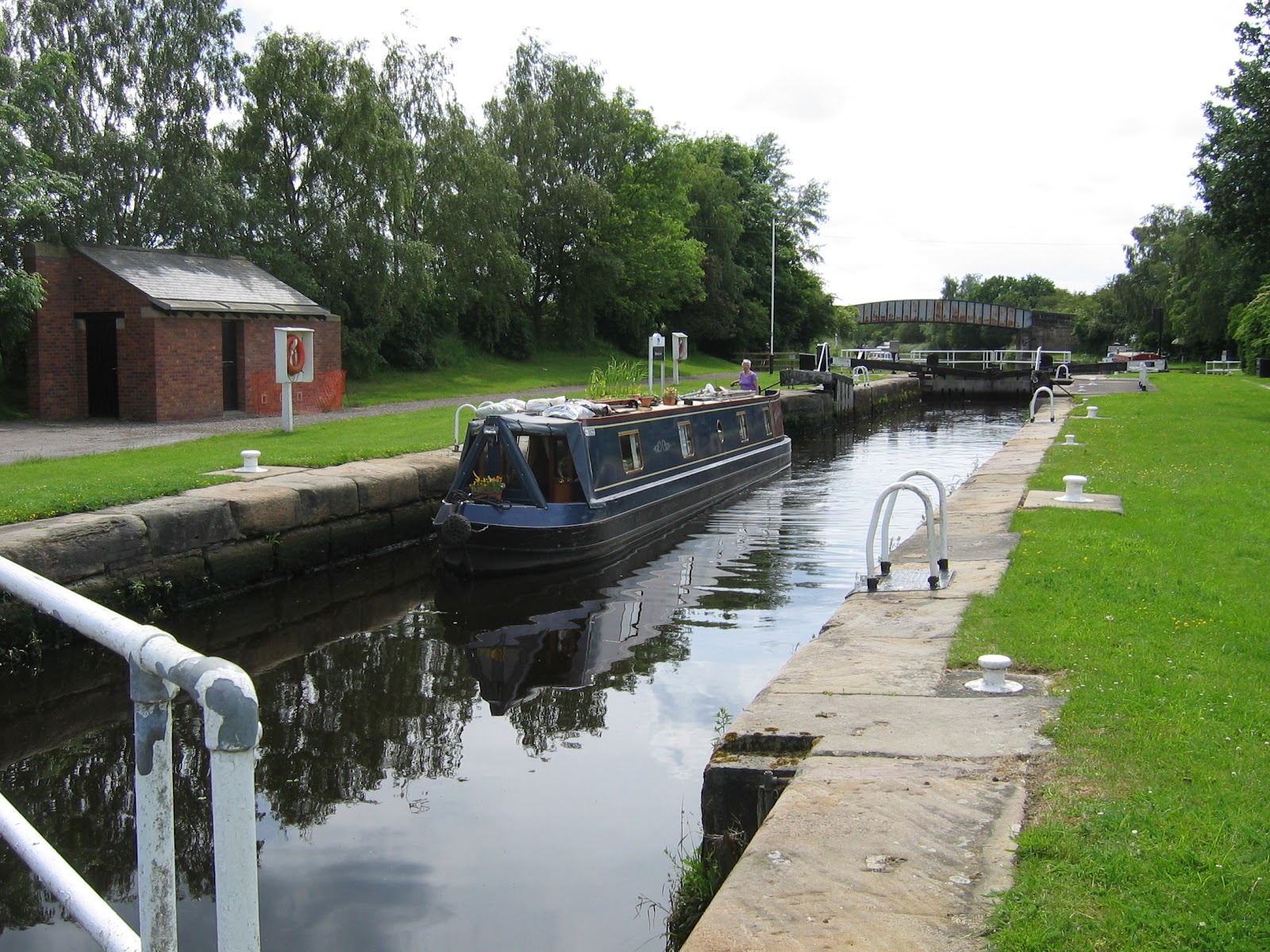
We stopped for lunch and so had a later lock all to ourselves, but this gives you an idea of normal-sized locks on the Aire & Calder –


 but no hard work is involved, just pressing buttons!  They are all mechanised with electrically-operated hydraulics.

At Castleford, where the Calder joins the Aire, we passed 'Dinky' again as he was setting off after shopping.  We waited for him at the gigantic Lemonroyd Lock and moored above for the night.  Here we are at Woodlesford Lock the next morning – about the same length but only 7'6" deep instead of 13'6".

The few miles up to Leeds were a bit of a race against time, as it had been raining through the night and we knew that the River Aire gets fierce when rain falls in the Dales.  Fortunately, all the river level indicators at the locks were 'on green', including this last one where the Leeds & Liverpool Canal turns off the Aire.

The next day, after more rain, the river was totally un-navigable, not quite a raging torrent but heading that way.  With later news of floods in Yorkshire and on the Rochdale Canal (upstream on the Calder) we were very glad that 1) we had made it safely onto the L&L in time and 2) that we hadn't opted to cross back over the Pennines via the Rochdale this year – we had talked about it as a possibility!

Sunday, June 24, 2012

Through Standedge and Down Into Yorkshire


Looking down from the hills above Dobcross, the mist obscures most of the valley through which we had travelled as Zindagi climbed up from Ashton-under-Lyne into the Pennine area of Saddleworth, once officially part of Yorkshire and still believed to be so by many diehards.

Now it was our day to travel through Standedge Tunnel. We cleared Zindagi's roof of the usual garden and other stuff, removed the front cratch and were all ready to go as we waited at the Diggle portal for the westbound boats to emerge.

Back in 2008, Zindagi had to be towed through Standedge (pronounced 'Stanidge'), while we rode in the electrically-powered tug, hearing the bumps behind us as our boat and two others collided with various rocky projections.  It did distract from the interesting commentary!


Since 2011, boat owners have been allowed to drive their own boats through the tunnel, with the help of a British Waterways 'chaperone' who knows the tunnel well and can give advice as needed.  Here is Terry, our very knowledgeable and helpful guide, when he had stepped off in an 'adit' to phone through our progress so far.

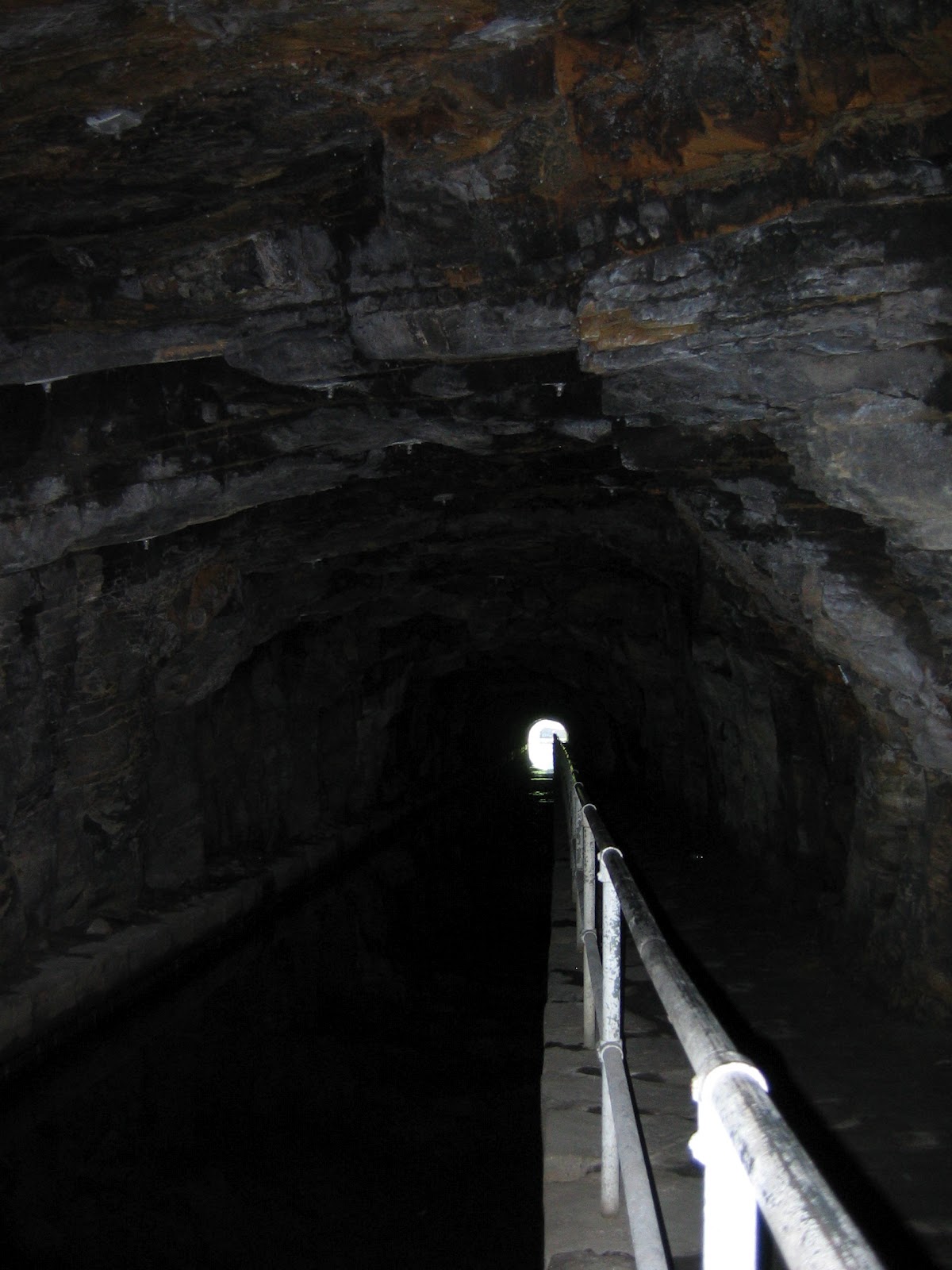
We arrived safely at the Marsden portal, having taken about 1¾ hours to travel through the 3-mile tunnel.  It took more than 2½ hours in 2008, and this time we had no paintwork damage other than the usual scrapes below the gunwales.


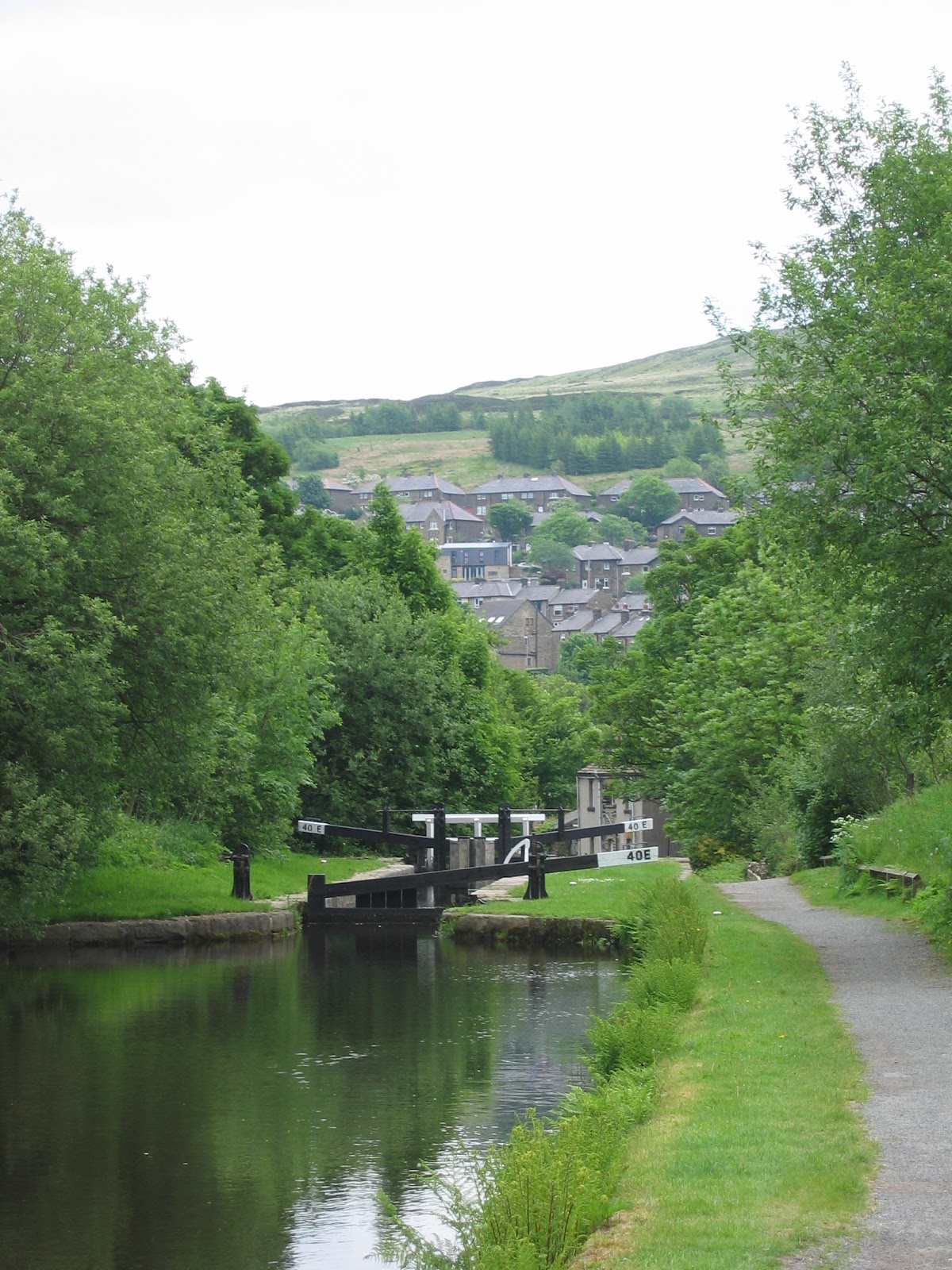
We had climbed up 32 locks from Ashton-under-Lyne on the western side.  42 more awaited us as we made our way down to Huddersfield, but we were in no hurry and started dawdling down the scenic Colne valley (here near Marsden).


Ten locks down (in only one mile!) and we found this lovely spot - so we stayed overnight until the next afternoon –


 and took just 2 hours to travel 1½ miles and another 8 locks down into Slaithwaite (pronounced 'Slawit'), with its unusual vertical steel guillotine lock-gate.  Lots of windlass-winding required!


A few days later, we found we had a pirate at the helm of Zindagi!  Yes, Shireen and Thor joined us for a few days, so we turned around and went part of the way back up to Marsden.


We walked up the rest of the way to Marsden village, and enjoyed our bagels at 'Crumbals-on-the-Corner'.


This helmsman certainly LOOKS like he knows what he's doing!

Back to Slaithwaite, Shireen & Thor back to Glasgow, and we continued our journey down the River Colne valley, passing the magnificent old Titanic Mill near Linthwaite, now restored and converted to 'Spa apartments'.


 . . . And so down to Huddersfield.  Last time we were here, this was a gloomy tunnel under Sellars factory, now a brand-new section of canal with a new lock - with building work still going on next to it!


Here we are, moored in Huddersfield, with the Victoria Tower on Castle Hill on the skyline.  News was that the River Calder was too high to navigate, so we had to stay a little longer than expected!

Saturday, June 09, 2012

Tunnels, Hills and Lots of Locks!


Coming down from the Caldon Canal and back into the edge of Stoke-on-Trent in the second week of May, we headed north-west on the Trent & Mersey and came to Harecastle Tunnel.  Probably the first canal tunnel we ever went through, back in the late 70s, before the old half-sunken towpath had been removed, forcing us to scrape the roof of our hire boat – they were very understanding!  No such problems now, despite the wildly varying headroom.  Zindagi's chimney had to be detached but the rooftop garden was OK.


A Peacock butterfly near Kidsgrove, where we turned off up the Macclesfield Canal.

Val operating the 'stop lock' at Hall Green.  Just a 1 ft rise, originally to stop one canal company 'stealing' water from another!  All the other locks on the 'Macc' are grouped together at Bosley, 10 miles further on.


Some beautiful stone bridges on this canal –


. . . and a good parade of goslings!


One of several 'snake' bridges on the Macc, this one at Congleton.  How to get your towing horse to the towpath on the other side of the canal, but without disconnecting the rope!


A late traveller coming down Bosley locks as we went for an evening stroll,


and Zindagi getting near the top of the flight the next morning.  12 locks - 120 feet rise, then another 16 miles of lock-free cruising (and dawdling) before we reached Marple towards the end of May.


Beautiful countryside, beautiful weather - at last!

Of course, having climbed up 120 feet at Bosley, at Marple we now needed to go DOWN 214 feet!  16 locks this time, bringing us down to Ashton-under-Lyne and the junction with the Huddersfield Narrow Canal.


Between Ashton and Huddersfield there are 74 locks in just 20 miles.  This is the second one, on the outskirts of Ashton, complete with old mill chimney and the Pennines looming beyond.


Eight locks behind us and the hills ahead.  A beautiful canal, with its own special challenges – mainly shallow water and frequent running aground, apart from so many locks.  Some people who travel this route say 'never again!'


Not us!  We came this way in 2008 and thought we would sample it again this year.  The little Scout Tunnel may be only 205 yards long, but you can clearly see the rough rock face.  A foretaste of a tunnel to come!


Flag irises nearby – only just coming out at the end of May.


Climbing up this valley which used to be filled with mills and industry . . .  Much of that has gone now, but there are growing and apparently thriving towns all the way, like here in the outskirts of Mossley.

Spring seemed to be reaching the pine trees, as we walked in the woods opposite our mooring near Roaches Lock.


But then the weather changed as we move further up the hills – lashing Pennine rain!


The railway line had been alongside us all the way from Ashton-under-Lyne, sharing the climb up towards Standedge.  Here the Saddleworth Viaduct soars above the canal . . .


 . . . but we had our own climbing to do!  The flight of 9 locks at Diggle would take us right up to the highest level navigable canal in the UK, 645 feet above sea level.

Despite our studious dawdling, we had arrived early for our passage through Standedge Tunnel, but it was worth a brisk walk up to see other boats at the Diggle portal, waiting to go through that day.  Dateline: 1st June.  Our encounter with Standedge was booked for the 4th!

Monday, May 14, 2012

Spring on the Caldon


Shortly after joining the Trent & Mersey Canal at Fradley Junction, we came up Wood End Lock, beautifully remote in the Staffordshire countryside.


More signs of a slowly emerging Spring at the end of April – Butterbur in flower near the canal . . . 

 . . . and Canada geese with their goslings (how about the contortions?!)

One of the distinctive 'Trent & Mersey' mileposts at Aston Lock, this one telling us that we were exactly at the mid-point of the Trent & Mersey as we approached the Potteries, just south of Stone.

Right at the heart of the pottery industry, Jesse Shirley's Bone and Flint Mill in Etruria, Stoke-on-Trent.  The pottery industry's need  for safe and speedy transport gave a major spur to canal building, with Josiah Wedgwood and others promoting the construction of the Trent & Mersey in 1766.

Just round the corner, the first locks of the Caldon Canal, as it rises out of Stoke towards the Caldon Low limestone quarries near Froghall, 17 miles away.

The night after we arrived, and most of the next day, the wind and rain hammered down.  We 'lay low' all day just outside Stoke, heard news of fallen trees on the Caldon and elsewhere, and even had to do a little tree surgery of our own in order to make progress the next day.


Up Stockton Brook locks and along the 'summit level' to 

Hazlehurst Junction, where the 'main line' goes straight on under the iron bridge and down the locks towards Froghall, while the Leek branch bears right and then crosses the main line on an aqueduct –


 where we moored for the night before chugging on towards Leek.


We moored in the 'Tunnel Pool' just before the short (130 yard) Leek Tunnel and enjoyed a circular walk down to the river, alongside the old railway, joining the canal main line and back along the Leek branch.


Through the tunnel to the edge of Leek for some shopping, then back to Hazlehurst and DOWN the locks, under the aqueduct and on down towards . . . 


Cheddleton, with its old water-powered Flint Mill, another connection with the pottery industry.


Adam and Lottie joined us there - Lottie's first time on board Zindagi!  She seemed to take to life on board very easily - she'll be back!


An almost timeless scene down at Froghall Wharf, where very few boats can go because of Froghall Tunnel's very low headroom.


Zindagi's rooftop garden flourishing in the (patchy) spring sunshine.


Adam, Val and Lottie on deck as Zindagi comes up a lock on the return journey,


 and passing the overhanging platform of the station at Consall Forge.  The Black Lion pub (ahead) had prepared an excellent Sunday lunch on our way down.

After taking Adam and Lottie back to the car, we started our own return to Stoke, leaving the quiet Caldon waters.  Spring still seemed a little elusive, but at least we had no snow as we did in March 2008!